Oklahoma Presidential Primary Election
Presidential candidates don't put an emphasis on winning Oklahoma, until now.
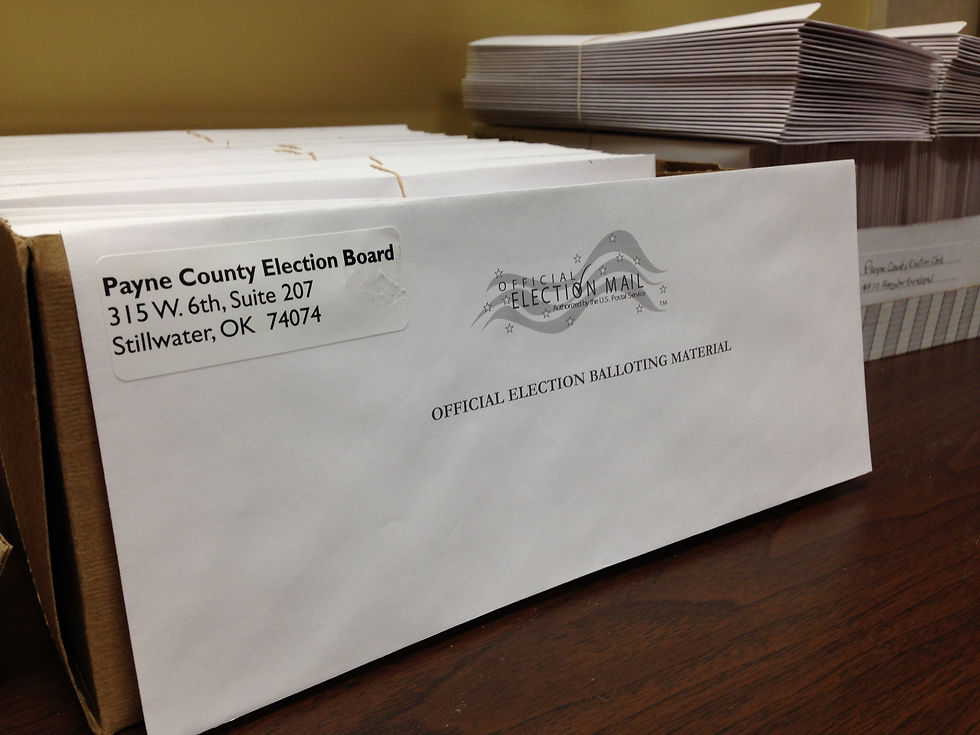
The Payne County Election Board accepts absentee ballots before official election dates.

Each absentee ballot goes inside multiple envelopes for confirmation and security.

The Oklahoma State Election Board refreshes the state and county vote counts every 30 seconds. Citizens can check the results of all state elections on the state election board website.
The Payne County Election Board accepts absentee ballots before official election dates.
Donald Trump and Hillary Clinton swept Super Tuesday, but Oklahoma held unexpected upsets on both sides of the ballot.
Democrat Bernie Sanders and Republican Ted Cruz won Oklahoma in the presidential primary.
Keith Gaddie from the University of Oklahoma said Sanders and Cruz’s wins were against the odds, but not completely unlikely.
“No one has ever accused the Oklahoma Democratic Party of being liberal, and they have voted for what is the most left candidate available in some time.” Gaddie said. “(Cruz) needed another win other than Texas, and this was going to be his best territory to get that, and he got it.”
The OU Department of Political Science chairman
said their success came from out-campaigning their
competitors. Sanders and Cruz spent the most time
and energy in Oklahoma out of all the candidates,
Gaddie said.
Sanders took the Democratic race with 52 percent
of the vote over Clinton’s 42 percent, according to
Oklahoma State Election Board data. Cruz was
Oklahoma’s Republican leader with 34 percent.
Among the Republican candidates, Trump came
in second at 28 percent with Marco Rubio right
behind at 26 percent. Ben Carson finished fourth
with 6 percent, and John Kasich was fifth with
4 percent.
Jeanette Mendez from Oklahoma State University
said Cruz and Sanders’ victories are helping their
campaigns stay alive, for now. The Department of
Political Science head said it will be difficult to overcome Clinton and Trump’s dominating performances Tuesday.
“Oklahoma doesn’t always pick the winner,” Mendez said. “I think this keeps them viable a little longer.”
Oklahoma was one of Sanders’ four state wins, including Colorado, Minnesota and Vermont. Cruz claimed Texas and Alaska along with the Sooner State.
Clinton and Trump each won seven of the Super Tuesday states.
The race in Oklahoma was predictably tight, and so were the delegate appropriations, Mendez said.
Sanders received 21 delegates from Oklahoma, and Clinton added 17, according to the Oklahoma Democratic Party.
Cruz earned 15 Oklahoma delegates. Trump received 13, just ahead of Rubio’s 12, according to the Oklahoma Republican Party.
Oklahoma has been a campaign battleground in the past weeks with several candidates pining for the state’s votes.
For the Republicans, Rubio, Cruz and Trump each had rallies in Oklahoma City last week.
Cruz was the most present, and it helped him earn the win, Gaddie said.
Oklahoma also became a key state in the Democratic race.
Sanders held rallies in Oklahoma City and Tulsa last week. Clinton never campaigned in Oklahoma herself, Gaddie said. Bill Clinton and campaign staff members came to meet with Oklahoma supporters, instead.
Gaddie said a win in Oklahoma would have been significant for Sanders or Clinton. Oklahoma’s demographics distinguish it from other southern states, he said.
Clinton has had overwhelming support from minorities in the South, Gaddie said. Several southern states have a dominant minority voter base, allowing Clinton to sweep much of the South.
Sanders has had to depend on white voters, which put him at a disadvantage in southern states, Gaddie said.
“The one place that’s southern in character where there’s not a big minority vote is Oklahoma,” Gaddie said. “Since Sanders is going to do well up north, Hillary’s going to do well down south, this has become a place where they both want to try and claim some sort of a moral victory.”
Clinton could have proven her ability to win without the minority vote with a victory in Oklahoma. Sanders can now claim strength in a deeply Republican state, Gaddie said.
Payne County had its own unique results.
Sanders won Payne County by a much wider margin than he did for the state. With 57 percent, he handily defeated Clinton at 39 percent, according to state election board data.
Rubio won in a tight race with 31 percent. He squeezed by Cruz’s 29 percent and Trump with 26 percent.
The president of the Payne County Republican Party said she wasn’t surprised to see Rubio win. Norma Shamblin said the county’s Republican culture showed in the results.
“I’ve seen Rubio tends to appeal to the more moderate person and educated person, and we have those types of Republicans here,” Shamblin said.
Sanders’ win came after extensive efforts, a campaign volunteer said. Angela Spotts said she has been heavily involved in volunteering for Sanders across the county, state and country.
Sanders’ campaign sent staff to Oklahoma right after the Iowa caucuses, Spotts said. They have been working with volunteers, young and old, to share Sanders’ message.
“They stayed invested in this state, and it paid off,” Spotts said. “We did phone banks. We knocked on doors, anything we could to truly just get people energized in Sanders’ voice.”
Republican voters appeared especially energized for their candidates. The director of operations for the Oklahoma Republican Party said turnout was at an all-time high for the state GOP. Jake Parsons said the Republican voter turnout has doubled since the 2012 election.
About 460,000 people voted in Oklahoma’s Republican primary, according to state election board results. Only 287,000 voted in the 2012 primary.
“(It) shatters every record by any party ever in Oklahoma,” Parsons said. “The Democrats allowed Independents in the primary for the first time ever, and yet we’ve got more than 100,000 more votes than they do in the primary.”
The communications director for the Oklahoma Democratic Party confirmed Parson’s statement. Sarah Baker said Independents were allowed to vote in the Democratic primary for the first time this year. Democratic turnout has been on the decline since 2008, Baker said.
The state Democratic Party compared this year’s turnout to the 2008 primary instead of 2012, she said. There was no incumbent president running in 2008, so Baker said that year gives a better comparison.
“Voter participation has been declining for the past several years across Oklahoma no matter what,” Baker said. “The Republican Party has seen a surge in registration and a surge in participation, but that’s largely due to kind of the dramatics of the candidates that they have running on the ticket whereas our candidates are focused on talking about issues.”
Mendez said the 2016 presidential race is unlike any she has seen. Many of the candidates appear determined to stay in the race until the end.
Super Tuesday normally thins out the competition to about two candidates for each party, Mendez said. That doesn’t appear to be the case for the GOP.
Sanders’ campaign will be more difficult going forward, but he doesn’t plan on stopping now, Mendez said. He has the chance to receive many more delegates in northern primaries.
With Super Tuesday in the rearview mirror, the remaining candidates have little time left to capture the nominations.
“We’re moving to a winner-take-all type of system,” Mendez said. “Being second place isn’t going to matter come March 15.”